

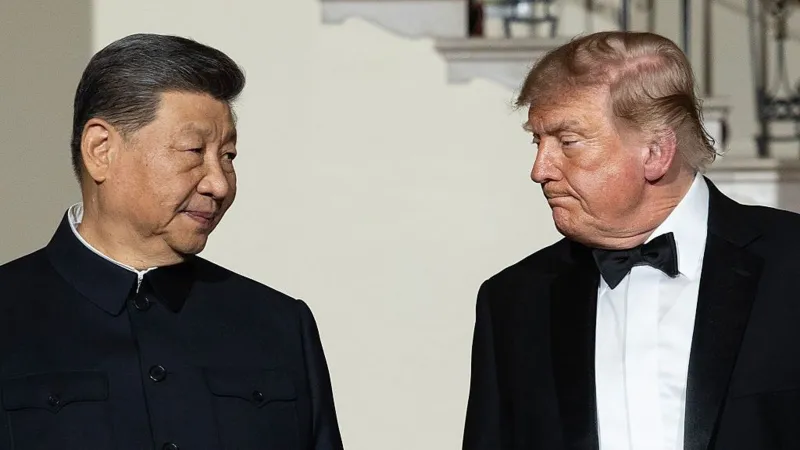
China has released additional details about last week’s meeting between President Xi Jinping and Donald Trump, revealing several concrete agreements but few major breakthroughs.
The two governments issued separate accounts of the talks rather than a joint statement, highlighting the cautious nature of the relationship despite efforts by both sides to present a warmer tone.
Here are four key areas where the talks produced agreements — and where major questions remain unanswered.
1. New AI Talks and a Direct Communication Channel
China says it has agreed with the United States to establish a new dialogue focused on artificial intelligence, with further discussions expected at the end of November.
The agreement comes as Washington and Beijing compete to develop increasingly advanced AI systems, while concerns grow over how the technology could affect national security, business and military planning.
The two sides also agreed to create a communication channel for AI-related incidents. The aim is to allow officials to address unexpected developments and reduce the risk of misunderstandings escalating into wider tensions.
AI was closely watched ahead of the summit, given the growing competition between the two countries over the technology and continuing debate about how quickly AI development should progress.
2. Trade Truce Extended, But Major Issues Remain
Chinese state media confirmed Monday that the existing US-China trade truce will be extended until Jan. 10.
The extension gives Trump and Xi another opportunity to meet at major international gatherings later this year. Trump is expected at the Asia-Pacific Economic Cooperation summit in Shenzhen in November, while Xi is due to travel to Miami for the G20 summit in December.
China had reportedly sought a significantly longer extension, making the two-month renewal a relatively limited step.
However, Beijing did secure lower US tariffs on $30 billion of Chinese goods, with reciprocal reductions expected from China. Products including toys, household appliances and Christmas decorations are among the goods expected to benefit.
The Trump administration also said China would purchase at least 10 million metric tons of coal annually in 2027 and 2028.
Several major disputes were notably absent from the announcements. There was no reference to increased Chinese exports of rare-earth minerals to the US, nor any indication that restrictions on advanced American semiconductors would be relaxed.
3. Taiwan Remains a Major Point of Uncertainty
Taiwan was absent from the White House factsheet on the meeting, but Beijing said the issue was raised prominently by Xi.
According to China’s account, Xi urged Trump to oppose Taiwan independence and approach the issue cautiously.
Trump offered little detail about the subject after the summit, saying the two leaders had not discussed it extensively.
The limited public comments stand in contrast with Trump’s previous remarks about Taiwan, including his description of a proposed $14 billion US arms package for the island as a potential negotiating tool with Beijing. The package has reportedly been on hold for months.
US Ambassador to China David Perdue also caused confusion when he told Fox News that Trump had offered to sell weapons to Xi during the summit. The State Department subsequently clarified that US law prohibits arms sales to China and that there are no plans to make such sales.
Beijing considers Taiwan part of China. While most countries, including the US, do not recognise Taiwan as an independent state, Washington opposes the use of force to seize the island and continues to provide it with weapons.
4. China Signals Greater Openness to Foreign Investment
China says it will allow more foreign financial companies, including US-backed banks, investment firms and insurers, to apply to establish operations in the country.
However, the companies would still have to comply with Chinese laws and regulations, meaning Beijing retains control over which firms ultimately receive approval.
Foreign financial institutions have long pointed to regulatory restrictions, licensing requirements and concerns about exit bans as obstacles to expanding their businesses in China.
The two countries are also discussing ways to increase flights between them, although neither government has provided details on how expanded air links would work.
China has introduced visa-free entry for visitors from more than 75 countries, but Americans are not currently included in that policy. Meanwhile, the US State Department continues to advise travellers to China to exercise increased caution, citing risks including arbitrary law enforcement, exit bans and detention.
What the Talks Actually Achieved
The summit appears to have produced more communication between Washington and Beijing than major changes to their most difficult disputes.
AI cooperation, trade and financial access all produced signs of movement, but contentious issues involving advanced technology, Taiwan and strategic resources remain unresolved.
For now, the two governments appear focused on keeping dialogue open and securing limited economic concessions rather than resolving the deeper disagreements that continue to shape US-China relations.

