

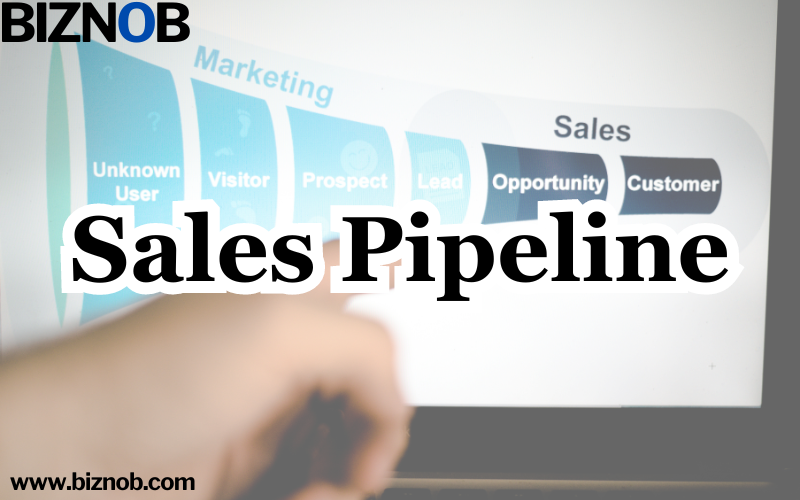
What is a sales pipeline?
A Sales pipeline shows the whole process, from the beginning to the end. It displays all the steps a customer takes to become a paid customer.
This includes getting in touch with a prospect for the first time, like with an email or a cold call, sending quotes and contracts, discussing terms and conditions, getting paid, and finally closing the deal.
Each part of the sales process, from sales prospecting to after the sale, can be broken down into smaller steps and put in the correct order. This makes it easier to keep track of, control, and improve the whole process, from beginning to end.
A pipeline is usually shown as a bar, which can be broken up into the different steps of a business’s sales process. Prospects and leads move to the next step in the pipeline as they go through this process, such as when reps get feedback on cold emails or decide whether a possible lead is a good fit or not.
Synonyms
- Sales Funnel: This is a way to see the sales process, which is similar to a sales flow but focuses on a different part of the process. A funnel isn’t meant to show the whole sales process; instead, it’s used to show how many leads are converted from one stage of the flow to the next.
- Sales Cycle: A more general term for the whole process, from beginning to end. It includes the stages where customers are actively engaged, marketing, onboarding, and support after the sale.
- Revenue Pipeline: A revenue pipeline is a structured, visual, or conceptual system showing how a business makes money. It includes all the different ways a business makes money through different streams. This pipeline could include many different sources, like direct sales, subscriptions, renewals, recommendations, partnerships, licensing, or anything else that brings in money.
Why building a sales pipeline is important
Any business that sells to other businesses needs to have a transparent sales pipeline showing the whole sales process. Companies can better track and handle leads when they have a clear pipeline. It also helps them see where they can improve their processes or get better results.
Quotas are more accessible to reach with sales systems.
Putting the sales process into smaller, more manageable jobs with pipeline stages makes everyone more accountable and makes it easier to meet sales KPIs.
When buyers use this method, they can always see exactly where their possible deals, money, and other efforts are.
This is especially important for people who have to deal with a lot of sales prospects at once, because they can’t miss any chances to make money.
When the steps of the pipeline are clear, fewer deals fall through.
A LinkedIn study shows that about 24% of deals that are expected to happen never do. Here are two of the main reasons for this:
- Account Churn: Every year, 20% of company executives leave their jobs.
- Internal Churn: Sales reps change jobs even more often—at a 25% rate per year.
These numbers don’t include things like employees leaving or moving jobs, company mergers, or changes in how the company is run, which are all things that can cause deals to fall through the cracks.
If you have a promising sales pipeline, all the information you need about the customer trip is in one place.
This makes it easy to keep track of leads and know what’s going on with them, no matter how long the sales rep has been working there.
Plus, having a complete picture of all the steps and activities keeps sales reps updated on their prospects’ wants, needs, and goals, which are all very important for closing deals.
Precise sales data is helpful for sales management.
A pipeline is a valuable tool for sales managers who want to gather information about how well their sales process is working (or not).
It’s even more valuable because it lets you see which tasks give you the best returns.
This solution lets companies fine-tune their approach and get the most out of their salespeople by keeping track of every step of their trip.
Making predictions about future income gets easier.
A clear sales path is constructive for estimating possible sales, making budgets, and making plans.
When you keep track of sales pipeline data, it’s easier to figure out how many deals can be closed based on the number of prospects in the funnel.
This lets companies know when the team can expect to meet its sales goals and gives them a way to measure success. Businesses can see when slumps are coming and where they might be able to find more leads or make more money by looking at this information.
Pipelining helps businesses figure out how fast their overall sales are going.
The average sales velocity is the usual amount of time between a lead and a customer. Sales pipeline management shows how quickly a salesperson turns interest into deals. This information helps businesses make sales predictions and get campaigns ready that are likely to be successful.
Companies can tell if their teams are excellently turning possible customers into paying ones by looking at the customer conversion time.
Better use of resources is made.
Companies can better use their resources when they handle their sales pipelines. By seeing how deals are moving, sales leaders can determine which reps need more help or resources and make the necessary changes.
You can also see which sales reps are wasting too much time on activities that don’t make them money instead of prospects who will turn into sales.
This information can even help marketing teams make better ads and messages that focus on the things that are most likely to lead to sales.
Leads at different points in the process can be taken care of correctly.
With the help of data from a sales pipeline, reps can keep in touch with possible customers and guide them through the whole process.
When sales reps know more about leads, they can tailor their interactions with each person to their needs, wants, and hobbies.
This helps you connect with possible new customers and makes getting to know them easier.
Income Pipeline vs. Sales Pipeline
First, knowing the difference between a sales pipeline and a revenue pipeline is essential. Then, we can talk about the steps of a sales pipeline and how to build one.
“Revenue pipeline” and “sales pipeline” mean the same thing but refer to different parts of a business’s operations. Here is a list of the things that make them different:
Pipeline for sales:
- The sales pipeline is a picture or systematic way of thinking about sales prospects and their steps from the first touch to closing a deal.
- It focuses on the sales process in detail, including finding new leads, qualifying them, meetings, making offers, negotiating, and finally closing a deal.
- The steps in a sales pipeline are based on the work of the sales team and are usually set up to show the buyer’s path from initial interest to purchase.
The revenue pipeline:
- The income pipeline is a more general term that includes more than just sales. It also includes other ways that a company makes money.
- It covers more than just sales. It could also include subscriptions, renewals, upsells, cross-sells, referrals, partnerships, and other ways to make money.
- It gives a complete picture of how a business makes money, not just straight sales. It gives a fuller picture of how money comes into the business.
If you think about it, the sales pipeline is part of the more significant income pipeline. The sales pipeline shows the steps and progression of activities related to sales. On the other hand, the revenue pipeline includes all the ways a business makes money, giving a more complete picture than just straight sales activities.
Stages of the Sales Pipeline
Each sales team’s steps in their pipeline will be a little different. For the most part, there should be eight main steps.
1. Lead Generation: This”prospecting,” is the process of getting contact information from different sources, like social media, email marketing, and so on, and storing it in a CRM system.
2. Qualification: Prospects are screened based on pre-set criteria to find sales-qualified leads based on budget, buy timeline, and decision-making process.
3. Needs Analysis: Figuring out if your product or service meets the wants and goals of your customers. This is usually done during a meeting or demo, where a sales rep or account boss finds out what the customer is struggling with.
4. Proposal or Quote: Giving buyers a personalized, correct proposal or quote that lists all the features and benefits of the product or service. Every organization’s proposal creation process is different, but it should always include an offer and a due date.
5. Negotiation: This means working with prospects to agree on the terms of a plan or quote that works for both parties. This could mean discussing pricing, payment plans, product benefits, etc.
6. Closure/Won: Signing a contract makes the deal legal. When a customer accepts the offer and decides to buy, the chance is said to be “closed.”
7. Lost/Not Closed: A customer is said to be “lost” or “not closed” if they decide not to purchase after being given an offer or quote. In the “Closed Lost” stage, you might discover why the deal fell through as a lack of cash or requirement fit. This helps you make decisions in the future.
8. Delivery (post-purchase): Check in with customers to ensure they’re happy with their purchase and know how to use the product or service correctly.
Knowing the different sales process steps helps businesses make better sales plans, use their resources more wisely, and build stronger relationships with customers to close more deals.
Ways to Make a Sales Plan
Although it’s not hard to make a sales pipeline, it takes a clear plan to make one that works well.
To make and use a promising sales pipeline, follow these seven steps:
Set criteria and steps for sales.
First, list all the steps in your sales process, from finding leads to delivering the goods. Make sure there are clear criteria for when a lead should move on to the next step at the end of each stage.
Set up tools and methods for sales.
Afterward, you must set up ways to handle customer relationships (CRM). This will help ensure that leads are handled and tracked well at all process stages.
Create a good program for training.
The training process for a new business client usually takes 100 days, but it should be different for each customer based on their needs. A good training program will help new customers get up and running quickly and make them happier in the long run.
Set up a way to follow up.
The Brevet study found that it takes at least five follow-ups to close 80% of sales. To help sales teams be more productive, close more deals, and save time, they need a way to respond to questions and send follow-up emails automatically.
Please find your ideal buyers and divide them into groups.
A business may have more than one ideal customer profile (ICP). It is essential to have a buyer persona and an ICP for each section, no matter what.
To do this, a business can look at customer information, like their job title, industry, and location. By learning about the people who buy your product or service and how they do it, you can make more effective efforts that lead to more sales.
Make a list of specific, possible connections.
You can list possible contacts using tools like ZoomInfo and DiscoverOrg to generate leads and platforms like LinkedIn Sales Navigator. The list can be filtered by job title and field.
Once you have a list of prospects, you can use marketing automation tools to make campaigns specific to each group.
Set up resources and use information to your advantage.
It is possible to watch performance, change resources, and measure trends as leads move through the sales pipeline.
Businesses should use data to determine what works and doesn’t, where leads get stuck, and which strategies will give them the best return on investment (ROI).
Looking at a Sales Pipeline
The sales pipeline isn’t a one-time thing that will work and doesn’t promise success either. A sales pipeline is like a live thing that must be changed and updated to keep working.
Companies should check their processes every three months (or more often if necessary) to ensure they work as efficiently as possible. In this case, the following key indicators will be looked at:
- The conversion rate shows how many leads in each stage move on to the next one.
- Close Rate: The number of leads that turned into actual buyers.
- Time-to-Close: How long does it take for a lead to turn into a valid customer?
- Average Deal Size: How much is each sale worth on average?
Any or all of these areas that aren’t doing well could mean that the sales process needs to be changed. Pipeline data is often an excellent way to see where those changes must be made.
Managing the sales pipeline
Sales pipeline management keeps an eye on and improves a sales pipeline so that more sales are made, and customers have a better experience. Among these are:
Setting out the steps in the sales process
- Setting up customer relationship management (CRM) systems to keep sound track of leads
- Creating follow-up methods to get more sales
- Making buyer profiles out of groups of possible buyers
- Using lead creation tools and marketing automation platforms to come up with targeted lists of possible contacts
- Putting together resources by analyzing data from leads as they move through the pipeline
- Regularly looking at success metrics such as the close rate and conversion rate
- Making the changes or adjustments that are needed to get the best results
Sales managers must remember these things to ensure the sales flow process goes smoothly.
Common Mistakes in the Sales Pipeline
Putting together a sales pipeline takes time, work, and focus. To avoid making these mistakes:
- You are putting too much emphasis on quick wins. When handling a sales pipeline, honesty about what you expect is essential. Any short-term losses should be seen in the context of the bigger picture as long as your team is meeting its goals and making the necessary changes.
- You are forgetting to focus on the customer. About 85% of business-to-business buyers think that the experience of buying is just as necessary as the product or service itself. It’s not enough to meet sales goals; a suitable sales method should also focus on giving customers a great experience.
- They are skipping over qualitative information. However, they only show part of the picture regarding performance. Companies should not only look at the numbers when a pipeline isn’t working as planned; they should also look at qualitative measures like customer comments.
- It is setting goals that can’t be reached. Sales goals must match business goals but should also be set with a sense of what’s possible. To avoid burnout, lousy performance, and employee turnover, you must balance your goals and your ability to reach them.
- They have not done anything since the purchase. Businesses should keep in touch with customers to ensure they have a good experience even after the sale. This could include new customer onboarding, ongoing support, and loyalty schemes.
Best Practices for the Sales Pipeline
Vantage Point research showed that even though 72% of sales managers review the pipeline regularly with their reps, 63% of those managers think their companies aren’t handling this process well. This gap shows that there is a huge opportunity for improvement. Here are some things you should always do:
- Figure out how to find leads that won’t turn into sales. Keeping track of these leads correctly is essential if they haven’t been active longer than your average sales cycle. In case of doubt, contact potential buyers and talk to them. Some prospects may move on to the next stage, while others may not be interested (or never reply, which is another clear sign).
- Make sales goals that are realistic for your team. Businesses can set realistic goals and make plans to better handle their sales efforts by laying out what an “improved close rate” means, how many leads they have, and how many deals they need to close.
- Don’t throw away good chances. Businesses can take advantage of times when their pipelines work well by trying new ways to make sales, doing more market research, or adding new products and services to their line.
- Set up feedback loops. As part of managing the sales pipeline, companies should measure things regularly to see what works best and make changes as needed.
- Make a place where people are responsible. Everyone should know what they need to do and be held responsible for how well they do it. This helps teams stay on task and motivated and keeps the pipeline going smoothly.
- Cut down on the time between sales. Shortening the sales cycle can be done by improving the value offer, putting together the right sales tech stack, and adequately training sales reps. It will be better for the customer and the business if the process is cut down.
- Set up a standard way to make sales. Making a sales playbook and sharing it with the team can help everyone work together more quickly and understand what needs to be done. It’s easier to train new sales reps when methods are standardized, which helps businesses increase.
- Write down everything you do in sales. All activities should be recorded and tracked to ensure that all sales processes are accurate and consistent. Businesses won’t know why they aren’t meeting their income goals without detailed information and will be less likely to meet their sales goals.
Technology for the sales pipeline
Digital sales change means using technology to bring a company’s sales processes up to date and make them run more smoothly. Manual methods might have worked in the past, but now that businesses want to stay competitive, they need to use these tools.
These are some of the main tools used to make pipelines work better:
CRM
Customer relationship management, or CRM, is a business approach that helps you get customers to interact with you more and build strong relationships with them.
CRM software automates and streamlines the sales, marketing, and account management tasks of a business so that they work as efficiently as possible.
It keeps track of all customer interactions, like emails, calls, meetings, and other things, which helps businesses handle their relationships with them. It also helps companies find trends and reach customers at the correct times by organizing customer information.
Some critical CRM features are:
- Keeping track of leads
- Making processes automatic
- Analyses and reports
- Keeping track of contacts
- Taking care of sales opportunities
91% of businesses with more than 11 people use CRM because it helps their sales pipeline in many ways.
CRM is most useful for businesses because it helps them learn more about their customers and potential customers. This lets them tailor their marketing messages and build relationships.
Automation in Marketing
Technology is used to automate marketing jobs like finding new leads, dividing customers into groups, and managing campaigns. This is called marketing automation.
With marketing automation, businesses can make campaigns that are automatically sent to customers based on their wants and preferences.
These are some types of marketing automation:
- Marketing by email
- Reporting and analytics
- Running social media accounts
- Getting leads and following up with them
These features make better use of resources by making manual tasks like entering data and managing contact lists easier. Businesses can also see real-time results of their marketing campaigns with marketing automation. This lets them figure out how well their campaigns are doing and make changes to improve them.
Making sales possible
Sales enablement gives salespeople the tools, training, and information they need to do their jobs well.
To help sales teams understand what their customers want, come up with custom solutions, and close deals faster, they need an integrated method.
A lot of different kinds of software are used as sales training tools, such as:
- Systems for managing content
- Lists of facts
- Tools for analyzing data
- Software for working together
The ultimate goal of sales enablement is to help workers interact with prospects in a variety of ways so that they make more sales and close more deals.
Businesses can make sure their sales team is as successful as possible by giving them the right mix of helpful material (like eBooks, white papers, blog posts, and case studies) and software tools (like AI-powered sales engagement platforms) to help them deliver it effectively.
Set up, price, and quote (CPQ)
Automating the pricing and selling process, configure, price, and quote software is meant to help businesses make their sales processes more efficient.
By setting up complicated goods, quoting, and billing, businesses can be more efficient, accurate, and quick with CPQ technology.

