

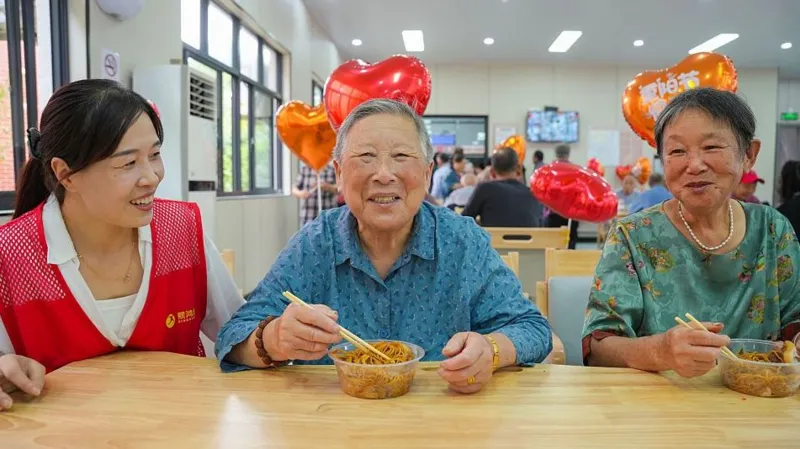
China has reached a significant demographic milestone, with families now supporting more elderly people than children, according to newly released government figures. The shift highlights the growing pressures an ageing population could place on households, public services and the world’s second-largest economy.
Official data show that China’s old-age dependency ratio rose to 23% last year, surpassing the child dependency ratio of 22%. The figures compare the populations of older people and children with the country’s working-age population.
China now has more than 223 million people aged 65 and above, representing nearly 16% of its total population. Meanwhile, approximately 213 million people are aged 14 and under.
The figures are being closely monitored for what they could mean for China’s shrinking workforce, pension system, healthcare spending and broader economic growth.
An Ageing Population Puts Pressure on Public Services
China has been preparing for an ageing population for years, encouraging younger adults to marry and couples to have more children. However, the latest figures underline the scale of the demographic challenge facing the country.
Chinese state-controlled newspaper Global Times attributed the shift to several factors, including the size of earlier birth cohorts and increasing life expectancy. It described the development as part of a longer-term demographic trend rather than a temporary change.
Professor Stuart Gietel-Basten of the Hong Kong University of Science and Technology said the milestone was symbolically important, potentially signalling a shift in public spending away from families and schools towards pensions and healthcare.
Mu Zheng, a sociology lecturer at the National University of Singapore, said the demographic transition could also constrain China’s economic ambitions by affecting growth and household spending power.
As the number of older residents increases relative to the working-age population, demand for pensions, medical services and long-term care is expected to grow.
The Legacy of the One-Child Policy
China’s ageing population reflects decades of demographic change, including rapid urbanisation and the effects of the country’s former one-child policy.
Introduced in 1980 and maintained until the end of 2015, the policy was designed to control population growth. The Chinese government has estimated that it prevented approximately 400 million births, although that figure has been disputed.
The policy contributed to a smaller younger generation, leaving fewer people available to support an expanding elderly population, Mu said.
Although Beijing has since relaxed family-size restrictions and introduced measures intended to encourage childbirth, birth rates have continued to fall to historic lows.
Changing gender roles, rising living costs and higher levels of education have also influenced decisions about whether and when to have children.
The combination of fewer births and longer life expectancy has accelerated the shift in China’s population structure.
Government Expands Support for Older Citizens
China has begun placing greater emphasis on elderly care as part of its economic planning. Measures to support older people were included in the country’s five-year economic blueprint announced earlier this year.
Government spending on financial assistance for pensioners has also increased. Official figures show that more than 53 million older people were receiving senior-citizen allowances and subsidies by the end of 2025.
However, ageing does not necessarily mean that all older people are financially dependent.
According to Global Times, many people entering retirement who were born between the 1950s and 1970s have higher incomes, greater purchasing power and better health than previous generations.
The growth of this population could also create opportunities for businesses serving older consumers, including healthcare providers, care services and companies supplying products designed for later life. These activities are often described collectively as the “silver economy”.
Why the Dependency Ratio Is Being Questioned
Although dependency ratios are widely used to measure demographic ageing, some experts argue that the figures provide an incomplete picture.
Gietel-Basten cautioned that describing older people primarily as dependants risks overlooking their independence and contributions to society. Many older adults remain active, healthy and economically engaged.
The ratios also do not fully account for improvements in healthcare or differences in employment, income and living conditions among older people.
China’s latest figures therefore point to a major demographic transition, but they do not automatically mean that every older citizen requires financial or practical support.
A Long-Term Challenge for China’s Economy
China’s ageing population is likely to influence how resources are allocated between pensions, healthcare, education and family support in the years ahead.
A smaller working-age population could create pressure on public finances and labour supply, while lower birth rates may affect future consumer demand and economic growth.
At the same time, healthier and wealthier older consumers could support new industries and services.
The central challenge for Beijing will be adapting its social welfare systems and economy to a population that is getting older, while addressing the factors discouraging younger generations from having children.
The latest dependency figures mark an important turning point in that transition, but experts caution that the ratios must be understood alongside the health, resources and contributions of China’s older population.

