

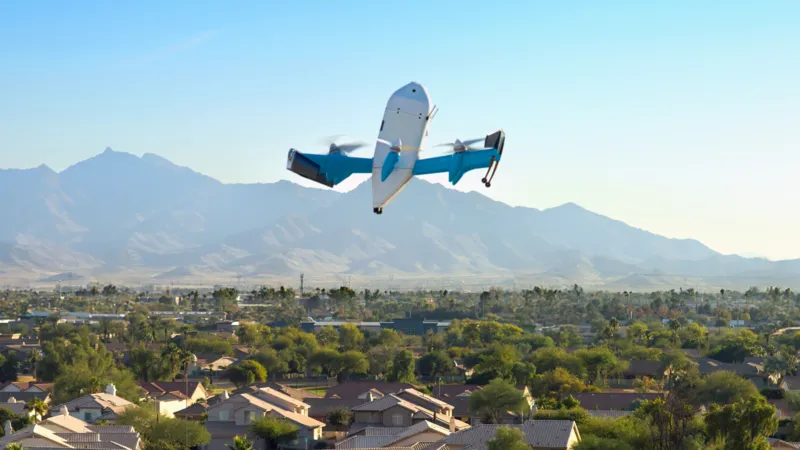
Ashley Schmidt has gradually abandoned some of her favourite outdoor activities because of the persistent buzzing of delivery drones flying over her neighbourhood in North Garland, a suburb of Dallas.
The 44-year-old administrative assistant, who enjoys observing nature, rarely spends time in her garden anymore. She has also stopped cycling to nearby parks, where she once photographed insects, lizards and toads up close.
The problem, she says, is the noise made by drones delivering online orders to her neighbours. Their buzzing can be heard as they approach, fly directly over her home and disappear into the distance. Schmidt describes the sound as extremely irritating and says it triggers her fight-or-flight response.
Her experience reflects a growing concern among residents in the United States as companies such as Amazon and Walmart expand drone delivery operations to make online shopping faster and more convenient.
Amazon Prime Air is extending its service to nearly 500 US towns and cities, delivering small packages that can fit into a shoebox. The company has also launched the service in and around Darlington, in northern England. Meanwhile, smaller operators in some American cities are using drones to deliver food and treats from local pizza restaurants and ice cream shops.
Although traffic noise is familiar in urban areas, the sound of drones can be harder to ignore. Their high-pitched rotor noise often cuts through the usual background sounds of a neighbourhood.
Antonio Torija Martinez, a professor of acoustic engineering and psychoacoustics at the University of Salford, says drone noise can be particularly noticeable even when overall sound levels are relatively low.
Unlike conventional aircraft, drones typically operate at lower altitudes and may fly directly over homes. This can introduce aircraft noise into communities that have not previously experienced much of it, making residents more sensitive to the change.
Research indicates that people tend to react more strongly to sounds they consider unfamiliar, intrusive or frequent. Residents who benefit from drone deliveries may be more accepting of the noise than those who experience the disturbance without using the service.
Torija Martinez expects complaints to increase as the industry expands beyond the areas where noise concerns are currently concentrated.
In the United States, commercial drone operations are regulated by the Federal Aviation Administration (FAA). The agency has faced criticism for permitting noisy delivery operations, but says drone operators and local community leaders have primary responsibility for addressing public concerns.
Technology developers are now working on ways to reduce the noise without compromising the performance of drones.
London-based startup Greenjets has developed a propulsion system that it says can cut drone noise by at least two-thirds. The company is targeting both the overall volume and the frequency of the sound.
Traditional drones use exposed spinning propellers that cut through the air, producing the familiar buzz. Greenjets instead encloses the spinning blades inside pods, which help muffle the sound and direct it away from the ground.
The company also reduces noise by slowing rotor speeds and using materials designed to limit vibration.
Quieter drones could have applications well beyond home deliveries. Greenjets says its technology has been used by police and harbour security teams in Germany, as well as conservationists in Africa who want to monitor poachers without revealing their presence.
Reducing noise is also important for military operators, whose drones may need to approach targets without alerting an opponent.
Robert Tollast, a research fellow at the Royal United Services Institute, says the US Special Forces have shown experimental interest in quieter drone technology. However, in the conflict between Russia and Ukraine, the priority for larger drones has generally been speed rather than reduced noise.
Another company exploring quieter propulsion is Sharrow Engineering, founded by Detroit-based entrepreneur Greg Sharrow.
His interest in drone noise began in 2012, when he needed to film a violinist from a difficult angle while broadcasting a classical music performance. A drone appeared to be the ideal tool, but its propellers were too loud.
Sharrow concluded that much of the noise came from the propellers rather than their motors. He focused particularly on the blade tips, which create noise as they move through the air.
This led him to develop a propeller with twisted, loop-shaped blades instead of conventional pointed tips. Testing the design in water proved easier than repeatedly flying a drone, so he initially concentrated on developing quieter boat propellers.
His company is now working on what it describes as ultra-quiet drone rotors. Sharrow says the technology has been tested in drone applications and produces substantially less noise.
Amazon and other delivery operators are also attempting to make their fleets less disruptive.
Amazon says it has achieved measurable improvements in the sound produced by its drones. Its latest models feature specially designed propellers that the company says generate almost half the perceived noise of the previous generation, with a softer tone.
Wing, whose drones are used for Walmart deliveries, says its propellers are designed to minimise noise. It also varies flight paths to prevent drones from repeatedly flying over the same homes and neighbourhoods.
For Schmidt, however, these improvements may not be enough. She says she would prefer drone deliveries in her area to be suspended until companies can find a way to operate without disturbing residents.
Her frustration highlights a growing challenge for the drone delivery industry: balancing convenience and faster service with the concerns of people who live beneath its flight paths. As more companies turn to the skies to deliver everyday purchases, the demand for quieter technology is likely to become increasingly important.

