

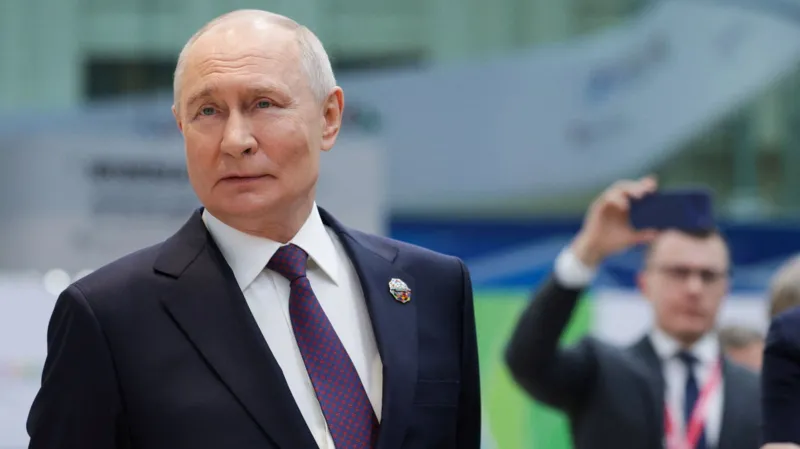
Russian President Vladimir Putin has praised billionaire entrepreneur Elon Musk as a “real genius”, revealing that Moscow is in close contact with the SpaceX founder over satellite technology and the need to prevent competing satellite networks from interfering with one another in orbit.
Putin made the remarks on Wednesday during the Russia-Africa Summit in Moscow, where he discussed Russia’s developing satellite internet service, Rassvet, which aims to provide internet connectivity through satellites.
“He’s a genius, a real genius,” Putin said of Musk, according to a BBC translation. “We are in close contact with our American partners, including Mr. Musk.”
Musk’s SpaceX operates Starlink, one of the world’s largest satellite internet networks. SpaceX had not responded to a request for comment at the time of the report.
Russia Develops Its Own Starlink Alternative
Putin said communication between Russia and its American partners was important to ensure that Rassvet and Starlink satellites did not interfere with each other in orbit.
He added that the two sides continued working together despite wider political tensions.
The Russian Embassy in South Africa described Rassvet as “Russia’s Starlink alternative”, while acknowledging that the project remained in its early stages.
The scale of the two networks differs considerably. According to the report, SpaceX has launched approximately 13,000 Starlink satellites, while online satellite trackers indicate that only a few dozen Rassvet satellites are currently in orbit.
The development of Rassvet reflects Russia’s efforts to establish its own satellite-based internet infrastructure as competition in the global space and telecommunications industries intensifies.
Starlink’s Role in the Ukraine War
The discussions come amid renewed attention to Starlink’s strategic importance in the war between Russia and Ukraine.
Ukraine has relied heavily on Starlink connectivity to support communications and military operations during Russia’s full-scale invasion. However, Ukrainian forces experienced sudden connectivity problems last week, which Musk acknowledged were caused by intentional action by SpaceX.
The incident highlighted the influence a private satellite network can have on communications in an active conflict.
The BBC report also noted signs of renewed engagement between Washington and Moscow, despite the continuing war in Ukraine. US President Donald Trump recently announced an agreement involving Russian diesel imports intended to help lower fuel prices, which had risen sharply amid the US war with Iran. Trump subsequently waived certain sanctions against Russia that had been scheduled to take effect.
Around the same period, a US citizen was released from Russian custody, with US envoy Steve Witkoff describing Putin as a “humanitarian”.
Musk’s Influence Extends Beyond Technology
Born in South Africa, Musk later moved to Canada before settling in the United States. His major business interests, including Tesla, SpaceX and Starlink, are based in America, with much of their operations concentrated in California and Texas.
The billionaire has also become a prominent political ally and financial supporter of Trump and other Republican politicians.
Putin’s public praise of Musk underscores the growing international significance of private space companies, whose satellite networks increasingly serve commercial, civilian and military purposes.
Although the precise details of the reported discussions between Musk and Russian officials remain unclear, the comments point to the importance both countries place on managing satellite activity as their respective networks develop.

